|
GTSM Technologies |



|
Home |


|
GTSM History |
|
Tensor Strain in California for NEHRP |
|
Tensor Strain in Taiwan |
|
Tensor Strain for PBO / Unavco |

|
Tensor Strain in Japan |
|
Mining Applications |
|
Stability Research |
|
Frequently Asked Questions |
|
Advanced Frequently Asked Questions |
|
Publications |
|
Contacts |
|
Tensor Strain for NSF’s PBO |
|
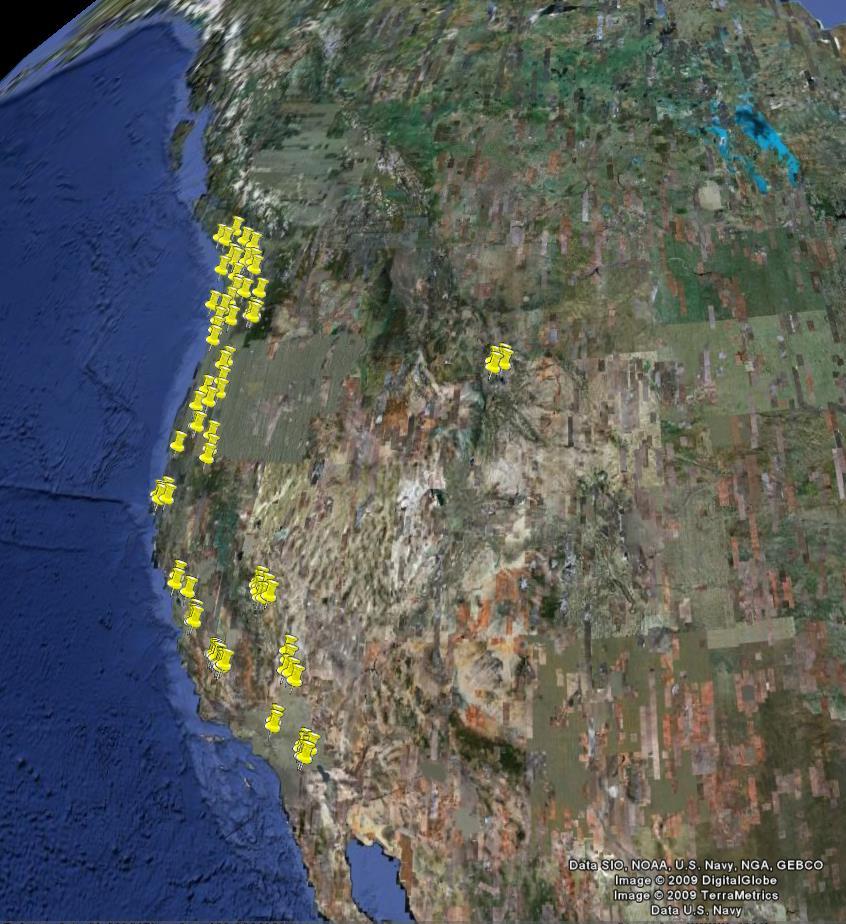
The PBO project aims to install 100+ GTSM instruments across the North Western region of the United States. This area will provide a useful of information due to a great deal of tectonic activity. The region has extensive GPS and seismic coverage and many different tectonic target types.
The Google map to the right shows the installations in 2005 and early 2006. For a large scale image showing all of the current sites, go to the Location Map.
For more details, visit UNAVCO for the Plate Boundary Observatory program of Earthscope, the major Research Equipment initiative (2004) of NSF.
New Videos to Unavco installations available: Overview of Anza Cluster and Hoko Falls Installation
GTSM Technologies is not involved in provision of the details or data for this array. We do, however, provide data from our home page to support the UNAVCO program and can also provide an advanced data visualization product (WinXqp) designed specifically for GTSM data processing. The complete data archive is available through the Unavco web site. A highlight for the Pacific North West array was the direct real time detection of one of the Dragert et al. silent slip events within two months of deployment.
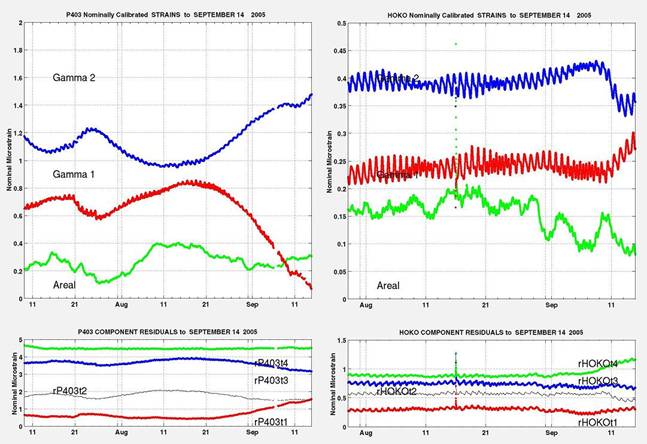
AUGUST SEPTEMBER 2005 A Cascadia silent slip event was expected late in August 2005. this event was observed at P403 and Hoko (B004) sites, see Location Map of sites. The event initially propagated through P403 in late August, and a second cycle was observed to begin at the HOKO strainmeter site around September 9. The total duration recorded to September 15 being about 18 days. Examples from the record are shown below.
JUNE 2005 An early start to a new era of PBO/GTSM borehole strain meters. With the grout only five hours old we had our first event in Northern California, the M7.2 of 02:50:54 on June 15, 2005, located 140 km west south west of Cresent City.
High frequency (20Hz) data was captured during this event. Obviously the data are recorded through very incompletely set grout with very low modulus. The figures are raw single component data with a nominal calibration of 0.1 nanostrain per count. Peak amplitudes are about 30 nanostrain. The beginning of the arrival on a 10 minute time scale is shown at figure 1 and figure 2 shows the subsequent ten minutes of the event as seen at HOKO. The three channels show are at azimuths 120 degrees apart. The record is equally interesting on the fourth channel. |